GRAMOPHONE Review: ‘Pájaros Mágicos’ Stravinsky The Firebird Suite · Villa-Lobos Uirapuru – Los Angeles Philharmonic Orchestra/Dudamel
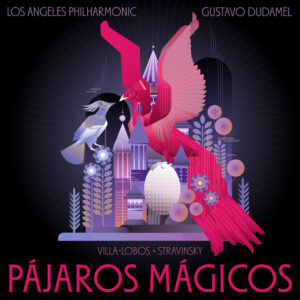 Two mythical birds – the one immortalised by Villa-Lobos – Uirapuru – an endangered species in our musical universe. All kudos to Dudamel for realising the songful connections with it and Stravinsky’s Firebird and rejoicing in them so wholeheartedly.
They were written within a decade of each other and you might even say that in the rarely heard Villa-Lobos ballet Stravinsky’s immortal bird was reborn in the Brazilian rain forest. Its ear-wormy chant, heard across flute and soprano saxophone, is brilliantly subsumed into its surroundings depicting nature in all its chirruping, rustling business. The exoticism, so characteristic of its composer, is offset by a stomping rhythmic propulsion plainly cross fertilised with Stravinsky’s other ground-breaking ballet of the period – The Rite of Spring. And there’s one other rare species – the Stroh Violin – which has a gramophonic horn attached to its bridge. Other worldly and then some. It’s a seductive eighteen or so minutes and Dudamel knows its sound world well coaxing all manner of sultry gorgeousness from his Los Angeleans.
The Firebird Suite is the second one Stravinsky made in 1919 paring back the opulent orchestration of the original ballet to achieve a sharper palette of sound and greater immediacy. These are essentially the big numbers of the score minus the transitional ‘pantomimes’ of the 1945 suite. Everything is in sharp relief here with the virtuosic LAPO winds in quite brilliant form. The ‘Dance of the Firebird’ is almost psychedelic in its light-catching colourations – fantastic articulation from every section. Then the oboe-led grace of of the ‘Dance of the Princesses’ all the woodwind voices individually singing to her beauty.
For my money conductors invariably take the ‘Infernal Dance of King Kastchei’ too deliberately. Not Dudamel. It has terrific pace. A pagan blast of hot air, brazen and flashy. And then the bassoon – has it ever been more songful? – serenades us towards ‘complete darkness’ its mystical shimmer of strings melting into near inaudibility. Always a heart-stopping moment and here is no exception. The new dawn of the close – one of music’s great perorations – makes the most of that rising cadence of brass chords without over-projecting the climactic cluster of notes in the sequence.
In short, nothing to fault here. Just brilliant.